

Why the Court of Appeal Only Listens to Matters of Law (Second Appeals in Kenya)
Most people assume that an appeal is simply a “retry” of their case. That assumption becomes even stronger at the second appeal stage. But in Kenya’s criminal justice system, a second appeal in Kenya is not a second chance to revisit facts. It is a narrow legal review focused strictly on whether the law was correctly applied.
1. When a case feels “unfair” but the law is already closed
Imagine this: a defendant is convicted in a magistrate’s court. He insists the witnesses were wrong. The High Court reviews the case on first appeal and still upholds the conviction. At this point, frustration builds. The natural belief is: “The Court of Appeal will finally see the truth.”
But Kenyan appellate law does not work that way. By the time a matter reaches a second appeal in kenya, the facts are largely settled. What remains is a legal question: did the courts below apply the correct legal principles to those facts?
This structure is deliberate. It prevents endless re-litigation and ensures finality in criminal proceedings while still allowing correction of serious legal errors.
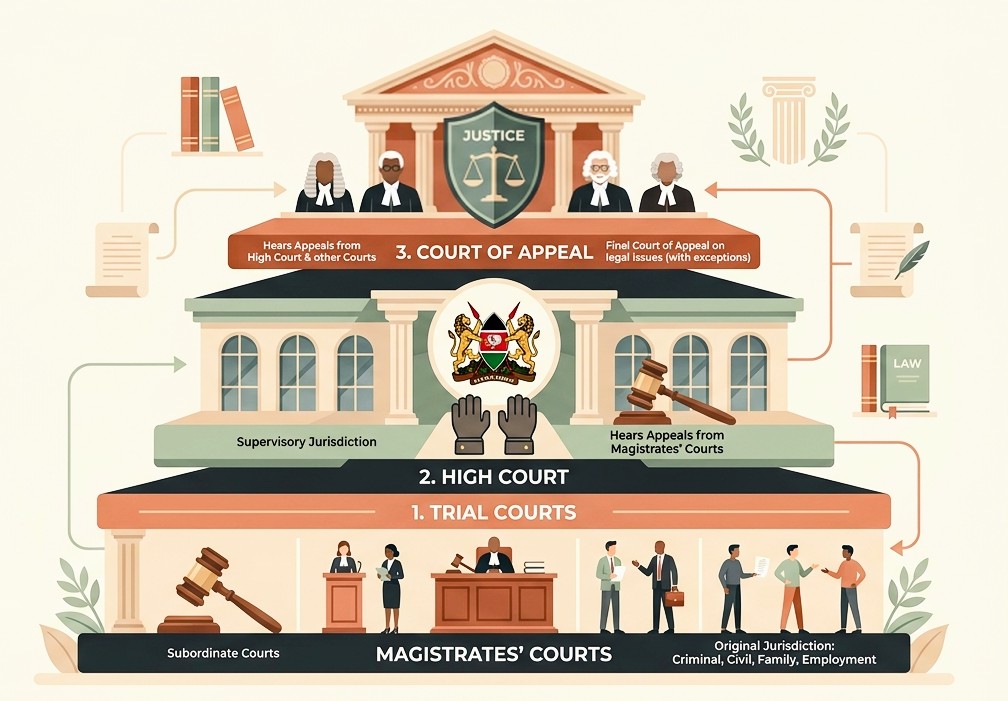
You can see this framework reflected in the Judiciary’s explanation of appellate structure, where the Court of Appeal is described as dealing primarily with questions of law rather than fact (Judiciary of Kenya).
2. Section 361 CPC: the legal boundary that changes everything
The foundation of second appeal limits is found in Section 361 of the Criminal Procedure Code. It restricts second appeals from the High Court to matters of law only.
In simple terms:
The Court of Appeal does not re-evaluate evidence. It does not decide who was more believable. It does not re-weigh witness testimony.

Instead, it asks:
- Was the correct legal test applied?
- Was the accused accorded a fair trial under the Constitution?
- Did the courts misinterpret or misapply the law?
Kenyan case law consistently reinforces this boundary. The official repository of decisions at Kenya Law shows repeated affirmations that second appeals are strictly limited to matters of law, with factual findings only disturbed in exceptional circumstances.
3. Fact vs Law: the confusion that drives most failed appeals
The most common reason second appeals fail is not lack of argument, but wrong framing. Many appellants present factual disputes as if they are legal issues.
A fact is what happened. A law is how the justice system evaluates what happened.
For example:
If a witness identifies an accused person at night, and the court believes that witness, that is a factual finding. But if the court fails to apply the correct legal standard for identification evidence—such as requiring caution in weak lighting conditions—that becomes a legal issue.
This distinction was reinforced in decisions like Karingo v Republic, where the courts emphasized that concurrent findings of fact by lower courts will not be disturbed unless they are unsupported by evidence or are perverse.
Similarly, in Samuel Awiti Karani v Republic, the Court of Appeal reiterated that second appeals are confined to matters of law only, reinforcing the jurisdictional limit.
These principles are not technicalities. They define whether a case is even eligible for reconsideration.
4. The “VAR principle”: how the Court of Appeal actually operates
A useful way to understand the system is to compare it to football VAR.
The trial court is the referee on the pitch, making immediate decisions based on live evidence. The High Court is the VAR room reviewing whether those decisions were reasonable based on the full record.
The Court of Appeal, on second appeal, is not replaying the entire match. It is checking whether the rules of the game were correctly interpreted and applied.
That means it does not ask “who played better.” It asks “were the rules applied correctly when making the decision?”
5. When factual issues become legal issues
Although the Court of Appeal avoids factual re-evaluation, there is a critical overlap zone where facts become law.
This happens when factual findings are built on a legal error.
For example:
- Relying on evidence that should have been excluded under constitutional protections
- Ignoring mandatory legal safeguards in criminal procedure
- Applying the wrong burden of proof
- Failing to consider material contradictions in a legally required way
In such cases, what looks like a “fact dispute” is actually a legal breakdown.
6. What the Court of Appeal will actually correct
On second appeal in Kenya, the Court of Appeal will intervene where there is:
- A misinterpretation of a statute or legal principle
- A conviction based on no evidence at all
- A procedural violation affecting the fairness of the trial
- A sentencing error where the law was misapplied
Kenyan appellate jurisprudence, accessible through Kenya Law reports, shows a consistent approach: concurrent factual findings are respected unless there is a legal collapse behind them.
7. Judicial consistency and why finality matters
The restriction on second appeals is not designed to limit justice. It is designed to balance justice with finality. Without it, criminal litigation could continue indefinitely, with every level re-arguing the same factual disputes.
By limiting second appeals to matters of law, the system ensures that:
- Trial courts remain the primary fact-finders
- High Courts act as full appellate reviewers of fact and law
- The Court of Appeal ensures legal consistency across the system
8. Mitey Judicial Perspective
Conclusion: the real question in a second appeal
A second appeal is not about asking, “Who is telling the truth?”
It is about asking, “Did the courts below apply the law correctly to the facts they found?”
That distinction is everything. Once understood, it becomes clear why the Court of Appeal does not reopen trials. It polices legal correctness, not factual disagreement.
In that sense, the second appeal is not a second trial. It is a legal audit.
Leave a Reply